


When is a high-quality UV tape sufficient, and when does UV-resistant piping make sense
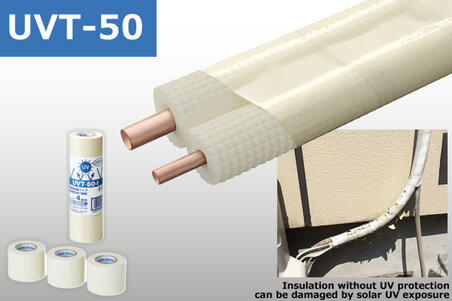
1) Practical problem: UV radiation degrades standard insulation
In outdoor sections of refrigeration and air-conditioning piping (especially between the unit and trunking/ducts or in open spaces), the most common weak point is the insulation, not the copper pipe itself. Standard elastomeric or foam insulations without protection gradually become brittle, crack, and deteriorate under sunlight, which opens the way to:
-
water ingress into the insulation and condensation,
-
reduction of thermal insulation performance (energy losses),
-
increased risk of failures and complaints (e.g. wet façades, stains, corrosion under insulation).
The manufacturer itself states that without protection, standard insulation deteriorates under sunlight and damage can lead to condensation and reduced system performance.
2) High cost–performance solution: UV-resistant adhesive tape UVT-50-I
INABA DENKO UVT-50-I is a UV-resistant PE adhesive tape designed to cover and protect exposed insulation sections in outdoor applications. The manufacturer describes it as a solution with strong resistance to solar radiation and suitable for protecting exposed insulation.
Basic specification of UVT-50-I (for project planning and cost calculations):
-
width 50 mm, length 20 m, thickness approx. 0.11 mm, ivory color, PE material.
Service life verification (commercial and technical context)
A “Certificate of UV Test” is available, stating that a result of 300 UV exposure cycles can be assumed to correspond to 12–13 years under Japanese conditions (calculated based on UV dose measured in the Choshi area, according to JWTC – Japan Weathering Test Center). At the same time, it is clearly stated that this is an assumption and that actual service life depends on the installation location and environmental conditions (temperature, humidity, rain, chemicals, etc.).
Practical conclusion:
For most standard outdoor installations, UVT-50-I is a very effective way to extend insulation service life and reduce maintenance interventions.
3) Comparison: (A) standard insulated copper piping + UVT tape vs. (B) copper piping with UV-resistant coating
A) Standard insulated copper piping + UV-resistant adhesive tape UVT-50-I
Advantages
-
Lowest additional cost with a significant increase in durability of outdoor sections.
-
Installation flexibility: the tape is applied only where needed (critical points, penetrations, bends, insulation ends, service loops).
-
Fast repair/renewal: in case of local damage, the tape can be easily reapplied without replacing the entire section.
-
Strong commercial benefit: a low-cost add-on that reduces claims and increases customer satisfaction (fewer return visits = higher project margin).
Disadvantages / risks
-
Performance depends on disciplined application (proper overlap, firm pressing into the insulation, no exposed areas left untreated). The manufacturer explicitly emphasizes the need to press the tape firmly into the insulation.
B) Copper piping with UV-resistant surface (UV-resistant coating / UV-resistant PE insulation)
Advantages
-
System solution: UV protection is integrated, reducing the risk of human error.
-
More suitable for projects where piping is fully and permanently exposed to UV radiation over long periods (without trunking or additional protection).
Disadvantages
-
Generally higher material cost.
-
In case of local damage, repair of the “clean” UV layer can be more complicated (often still requiring additional taping or covering).
Key practical argument
Product materials state that UVT-50 is intended to have the same UV resistance as a “New UV Resistant P.E. insulated copper tube,” according to the manufacturer’s internal measurements.
This means that in many typical applications, the required UV resistance can be achieved more economically and flexibly by using adhesive tape.